Journey
Khiva — The museum city that never closed

The museum city that never closed

Khiva

A complete walled city of clay and turquoise at the edge of the desert.

Khiva is the far end of the classical route, and it feels like it: beyond Bukhara the land empties into the Kyzylkum desert, and then, out of the haze, a perfect crenellated wall appears with a city folded inside. Itchan Kala — the inner town — is fifty monuments and a few hundred households packed into half a square kilometer.

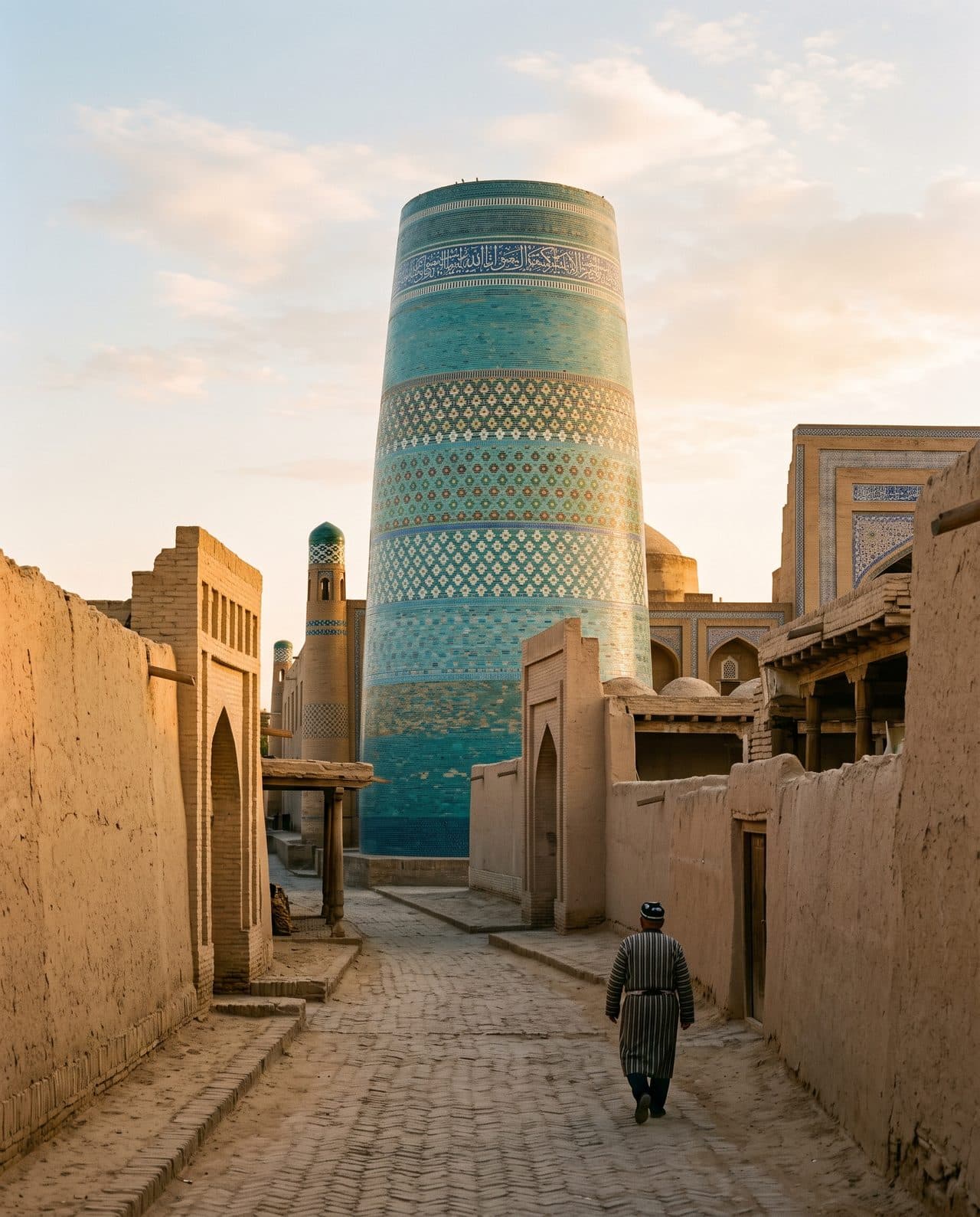
Everything here is the color of the desert it came from, fired clay and sand plaster, which is why the bursts of turquoise — the stub of the Kalta Minor minaret, the ribbed dome of Pahlavon Mahmud — land with such force.

Khiva rewards a night's stay. The day-trip crowds drain out by six; then the swifts take over the minarets, the walls turn to amber, and you can walk the entire city in an evening with the streets nearly to yourself.

Worth your hours

What to see in Khiva

Kalta Minor

The 'short minaret' — a vast turquoise-banded cylinder that was meant to be the tallest in the Islamic world until its khan died in 1855. Its unfinishedness is its charm.

Tip · It photographs best from the west gate lane in the last hour of light.
Itchan Kala walls

Two kilometers of massive sun-dried brick, walkable in sections, with the desert visible from the parapets.

Tip · Climb near the north gate for sunset over the rooftops.

Juma Mosque

A hypostyle hall of 213 carved wooden columns, some over a thousand years old — a forest indoors, cool in any heat.

Tip · Look for the two oldest columns, 10th-century, near the center; a caretaker will point.

Tash Khauli palace

The khans' town palace: courtyards of blue majolica, carved elm columns on stone bases, and a harem wing of five identical iwans.

Tip · Mornings are quietest; the tile detail deserves slow looking.

Pahlavon Mahmud mausoleum

Khiva's patron saint — poet, philosopher, wrestler — under the city's most beautiful dome. The tile interior is the finest in Khorezm.

Tip · Modest dress; it is Khiva's most active pilgrimage site.

Islam Khodja minaret

Khiva's tallest, banded like a lighthouse. The climb is steep, dark and narrow — and the view is the whole oasis.

Tip · Go early: the stairwell is single-file and heats up fast.

At the table

Eat like it matters

  • Shivit oshi

    Khiva's own dish — bright green dill noodles under meat and vegetable stew. Found almost nowhere else.

  • Tuhum barak

    Silky egg-filled dumplings, a Khorezm specialty, eaten with sour cream.

  • Green tea on the walls

    Cafés set tables against the ramparts; dried melon on the side.

  • Khorezm melon

    In late summer, the oasis melons are a national argument-settler.

The practical truths

Before you go

Season
April–May and September–October are comfortable; summer regularly passes 40°C. Winter is cold but the empty clay city under snow is unforgettable.
Getting there
Fly Tashkent→Urgench (1h40m) then 30 minutes by road; or the sleeper/day train to Khiva station just outside the walls. The Bukhara–Khiva drive crosses the Kyzylkum in 6–7 hours.
Local customs
  • Itchan Kala is a lived-in city — lanes between monuments are people's front doors.
  • The combined monument ticket covers most sites for two days; keep it on you.
  • Carry cash; card terminals inside the walls are still a rumor.