
Journey
Samarkand — The crossroads of the Silk Road

The crossroads of the Silk Road

Samarkand

Where Timur built an empire's showcase, and the tiles still hold the sky.

Samarkand is older than Rome and was already ancient when Alexander took it in 329 BC. But the city you come for is Timur's: at the turn of the 15th century he dragged the best builders of the conquered world here and told them to make his capital impossible to forget. They obeyed.

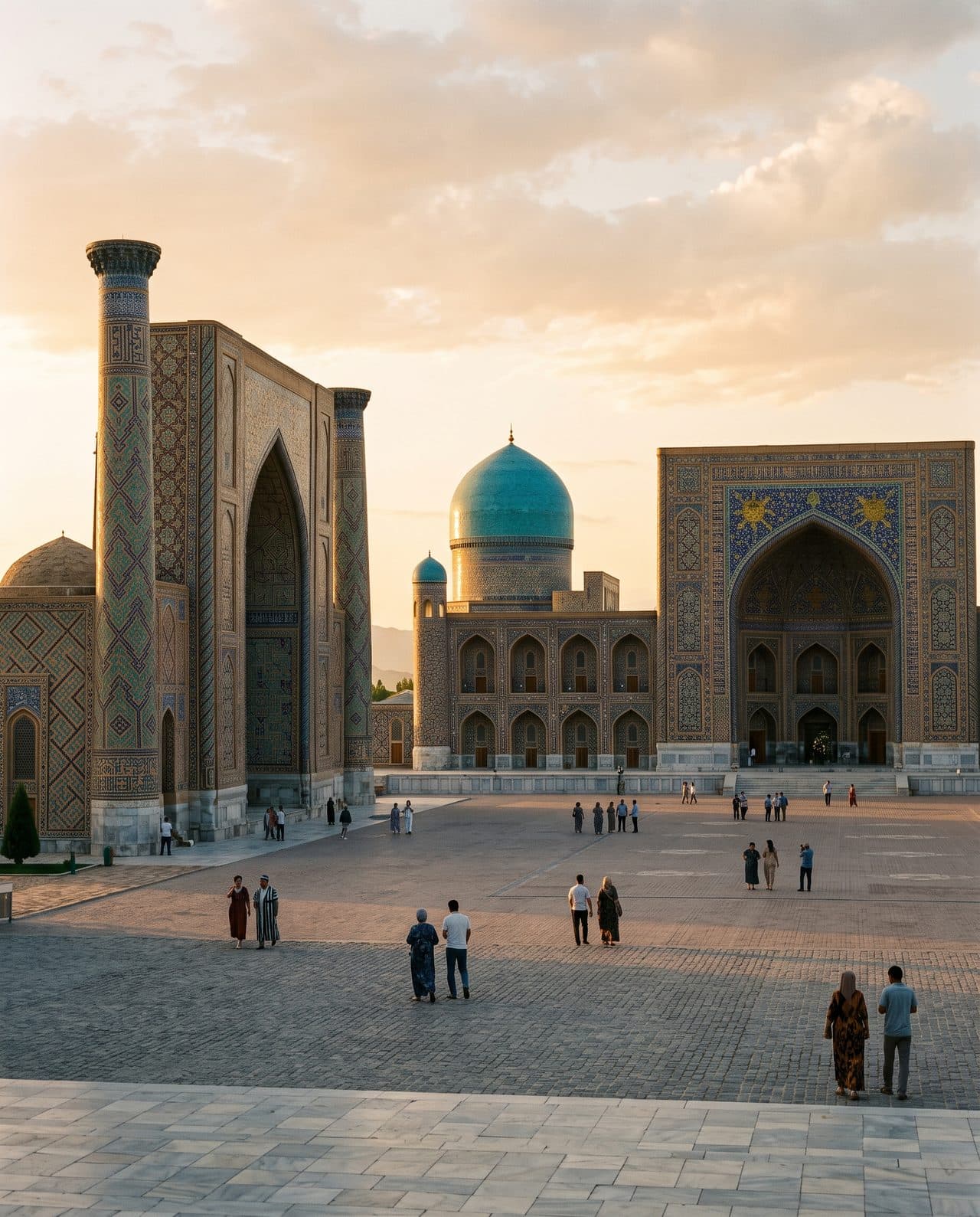
The result is the Registan — three madrasas facing a square that functions like an amphitheater for architecture. Stand in its center in the late afternoon, when the tour groups thin and the sun drops low enough to set the majolica burning, and you understand why every Uzbek schoolbook, banknote and dream contains this place.

Around it, the city is layered like a torte: Soviet avenues over tsarist grid over medieval lanes. Ten minutes' walk from the Registan you can drink green tea in a mahalla courtyard where the plov recipe hasn't changed since anyone's grandmother can remember.

Worth your hours

What to see in Samarkand

Registan Square

Three madrasas — Ulugbek, Sher-Dor, Tilya-Kori — form the most photographed ensemble in Central Asia. The gilded ceiling inside Tilya-Kori is the one that silences people.

Tip · Come twice: mid-morning for the tilework detail, and 30 minutes before closing for the empty square.
Gur-e-Amir

Timur's mausoleum, a fluted turquoise dome over a chamber of gold and onyx. The jade tombstone below marks the man who reshaped a continent.

Tip · Evening illumination flatters it; the interior is best in soft morning light.

Shah-i-Zinda

A narrow street of mausoleums climbing the hillside, each façade a different answer to the question of what blue can do. Still a working place of pilgrimage.

Tip · Go at opening time. By ten the lane is a river of elbows.

Bibi-Khanym Mosque

Timur's victory mosque, built too big too fast and beautiful in its slow ruin. The scale is the point — the portal alone is 35 meters.

Tip · Combine with the Siyob bazaar next door while the bread is still warm.

Ulugbek Observatory

The remains of the great sextant with which Timur's astronomer grandson measured the stellar year to within a minute — in 1437.

Tip · The small museum gives the context the trench itself can't.

Konigil paper mill

A watermill village workshop where mulberry-bark paper is made the way it was when Samarkand supplied the caliphate's calligraphers.

Tip · Buy a sheet; it outlives any postcard.

At the table

Eat like it matters

  • Samarkand plov

    Cooked in layers rather than stirred — served before noon, gone by one.

  • Samarkand non

    The dense, glossy bread stamped with the city's pattern; locals carry it home across the country.

  • Tandir kabob

    Lamb slow-sealed in a clay tandir; order where the queue is Uzbek.

  • Halva from Siyob bazaar

    A dozen varieties at the sweets rows; taste before you commit.

The practical truths

Before you go

Season
April–June and September–October are ideal: 20–30°C and clear. July–August exceeds 35°C; winter is quiet, cold and often beautifully sunny.
Getting there
The Afrosiyob high-speed train from Tashkent takes 2h10m — book a morning departure and arrive before the heat. Daily flights serve longer hops.
Local customs
  • Dress modestly at working religious sites; shoulders and knees covered is enough.
  • Photography inside mausoleums is usually fine without flash — ask when a caretaker is present.
  • Accept tea when offered; refusing outright reads colder than one symbolic sip.